

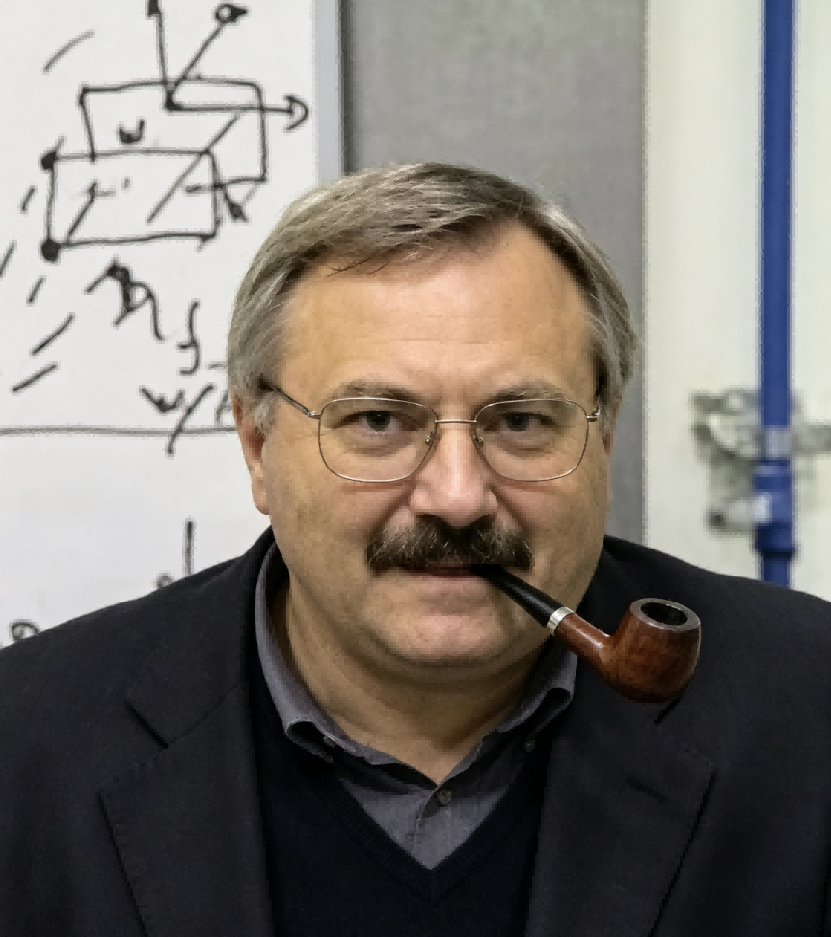
Professor Kleeorin’s research encompasses the turbulent transport of magnetic fields, mean-field electrodynamics, solar and stellar dynamos, magnetic instabilities in stratified convection, and internal gravity waves in geophysical flows. His collaborative work with Professor Igor Rogachevskii has led to major advances in the nonlinear theory of the shear-current effect and mean-field dynamos, the evolution of magnetic helicity during the solar activity cycle, and the formulation of mean electromotive forces in magnetohydrodynamic turbulence under weak magnetic fields and slow rotation. He has also contributed to the theoretical prediction and interpretation of the negative effective magnetic pressure instability (NEMPI), providing important insights into the emergence of large-scale magnetic structures in stratified turbulent systems. His work bridges fundamental turbulence physics with atmospheric modelling, solar activity, and astrophysical plasma dynamics. His selected publications on rotating stratified turbulence, EFB closure theory, solar magnetic activity, chiral MHD dynamos, and magnetic structures in rotating turbulence reflect a sustained programme linking rigorous theoretical physics with problems of broad significance in geophysics and astrophysics.

The International Academy of Eurasian Sciences is an international scientific organisation established in January 1994 and registered in the United Nations as a non-governmental organisation of UNESCO.
International Eurasian Academy of Sciences ASEAN Centre
secretariat@ieasth.org membership@ieasth.org